ReconnectChina project represented at the Asia-Europe Youth Summit on Science and Technology Diplomacy

40 young diplomats, policymakers, and research & science managers, coming from 29 countries across Asia and Europe, gathered in Copenhagen, Denmark, between 14-18 December 2025, for the first Asia-Europe Youth Summit on Science and Technology Diplomacy.

Co-organised in correlation with the second European Science Diplomacy Conference by the Ministry of Foreign Affairs Denmark and the Central European Scientific Society of Innovation and Technology (CESSIT), the Youth Summit served as a final event for the alumni of the Asia-Europe Training on Science and Technology Diplomacy.

The Youth Summit was a unique opportunity for the participants to engage in an interactive knowledge exchange experience in a relaxed but professional environment with the ultimate objective of drafting a Asia-Europe Youth Communiqué on Science and Technology DiplomacyGábor Szüdi from the Centre for Social Innovation (ZSI) represented the Reconnect China project during a World Café Dialogue to offer practical insights about the different perspectives and aspects of the complex ecosystem of science and technology diplomacy efforts between China and the European Union. The relevant project results achieved in the intersection of science, technology, and international relations thus could enrich the eventual viewpoint of the finalised Youth Communiqué.


More details about the Youth Summit is available at the Asia-Europe Foundation website.
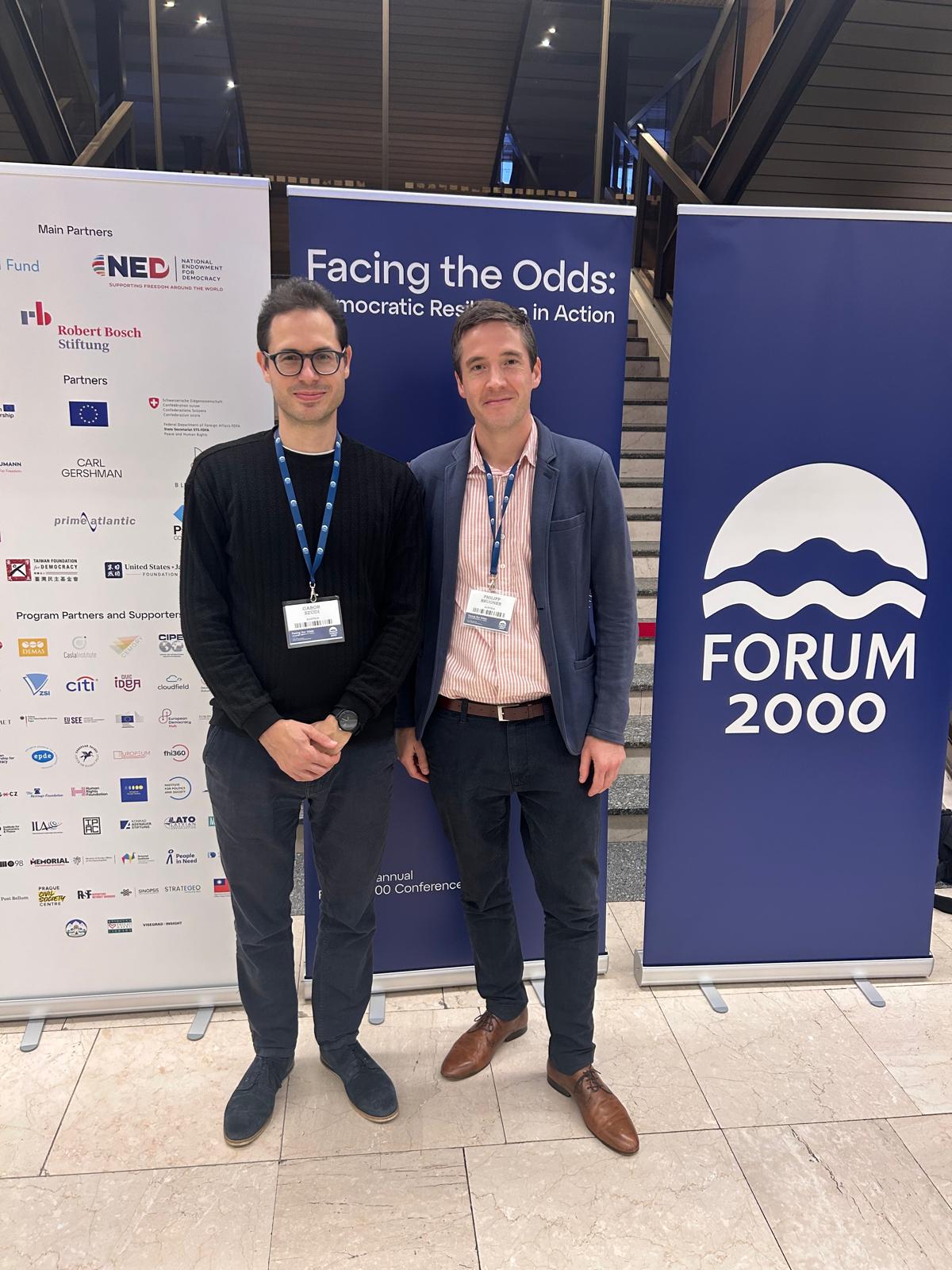


Reconnect China expert workshop on research security held at Forum 2000 conference

The annual Forum 2000 conference is a globally recognised event held in Prague that brings together world leaders, thinkers and experts to address fundamental challenges facing democracies, human rights and the international order.

The 29th annual forum was held between 12 and 14 October in Prague where Reconnect China partner ZSI was invited to hold an expert workshop on the future of Sino-European research and innovaton cooperation. ZSI researchers Philipp Brugner and Gábor Szüdi moderated a lively discussion of 10 experts from around the globe to delve into the feasibility of five policy recommendations – based on previous research within Reconnect China – on how to reduce research security risks for European partners when cooperating with China. The participants had a chance to co-design future scenarios on how future R&I cooperation could be made more sustainable and aligned with European values, including academic freedom, research integrity, research ethics and open science.

The five policy recommendations on research security discussed at the workshop are available within Reconnect China Policy Brief No. 12 “Knowledge and Perception of Research Security – the Case of Research Cooperation between Austria and China” by Gábor Szüdi & Philipp Brugner

More information on the conference can be found at the official website.

Research from ReConnect China at the EU-SPRI and ENTRANCE conferences in Germany

Research results from our work area on EU-China cooperation in science, technology and innovation were presented in two conferences in Germany before the summer. Philipp Brugner from our partner ZSI delivered these presentations, drawing on the work done with his colleague Gábor Szüdi in their trans-European survey on research security in the cooperation with China, which was implemented on behalf of the ReConnect China project between May 2024 and January 2025.

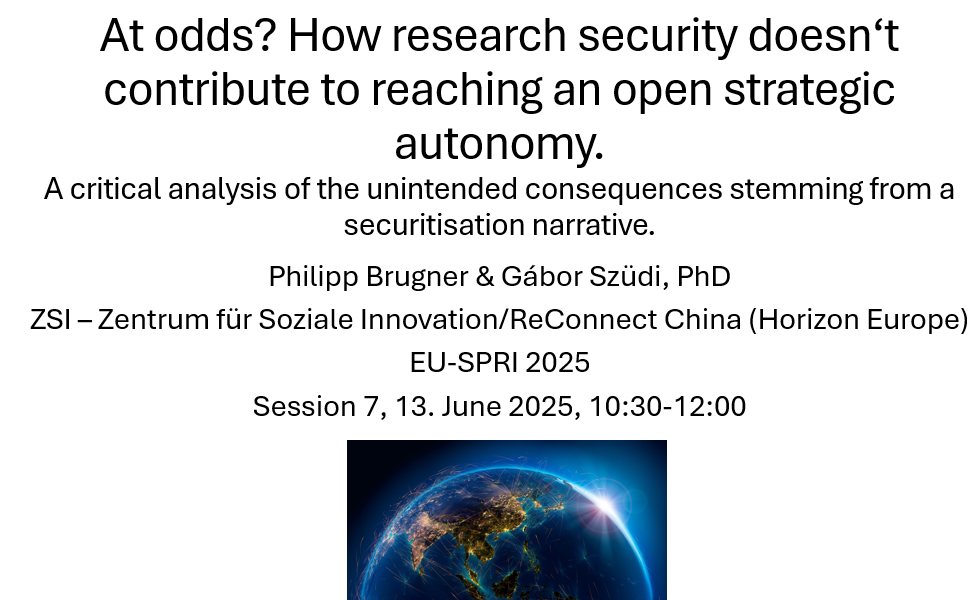
At the EU-SPRI annual conference 2025 at the Technical University Dortmund (11-13 June 2025), Philipp took part in the session titled “From (in)dependence towards resilience: tensions and synergies between open strategic autonomy and transformative research and innovation policies” and presented the survey findings in the light of the EU’s open strategic autonomy discussions.

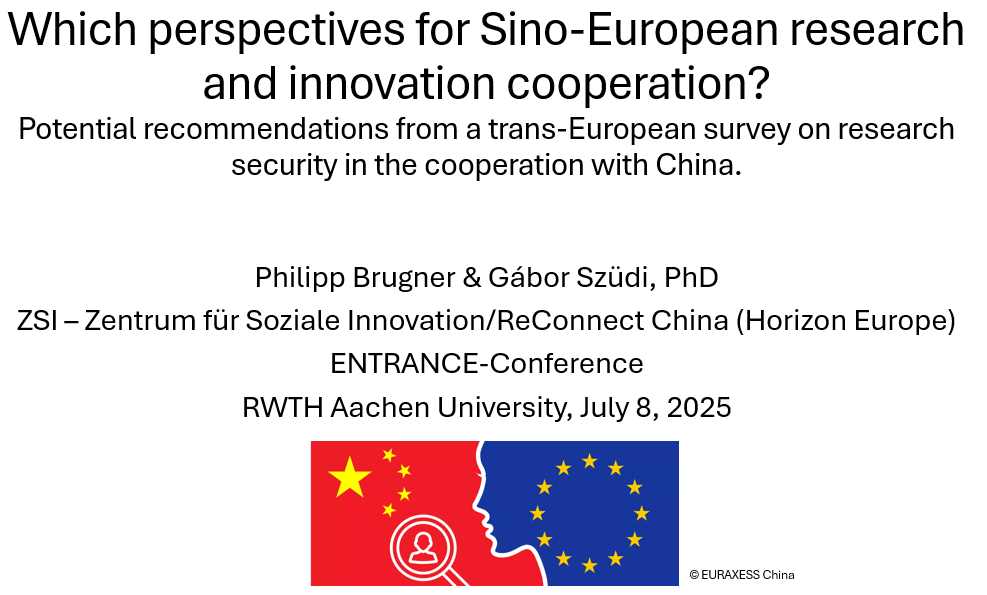
Only a few days later, at the ENTRANCE conference “Lessons Learned: Navigating Experiences from Sino-European Cooperation for Future Global Engagements” (7-8 July 2025), Philipp participated in the concluding panel discussion and gave an outlook on potential recommendations for future EU-China cooperation in R&I derived from the policy brief written by ZSI.

The consolidated findings of ZSI’s research will be published in the forthcoming Routledge International Handbook of Research Security (2026). A first glimpse into the handbook’s content is available through Routledge.

(featured image von Alexandre Pellaes auf Unsplash)


Second school visit in Austria by our partner ZSI

After our first school visit in Vienna in October, we went to Hartberg, a small Austrian town, on December 13 for the second round.

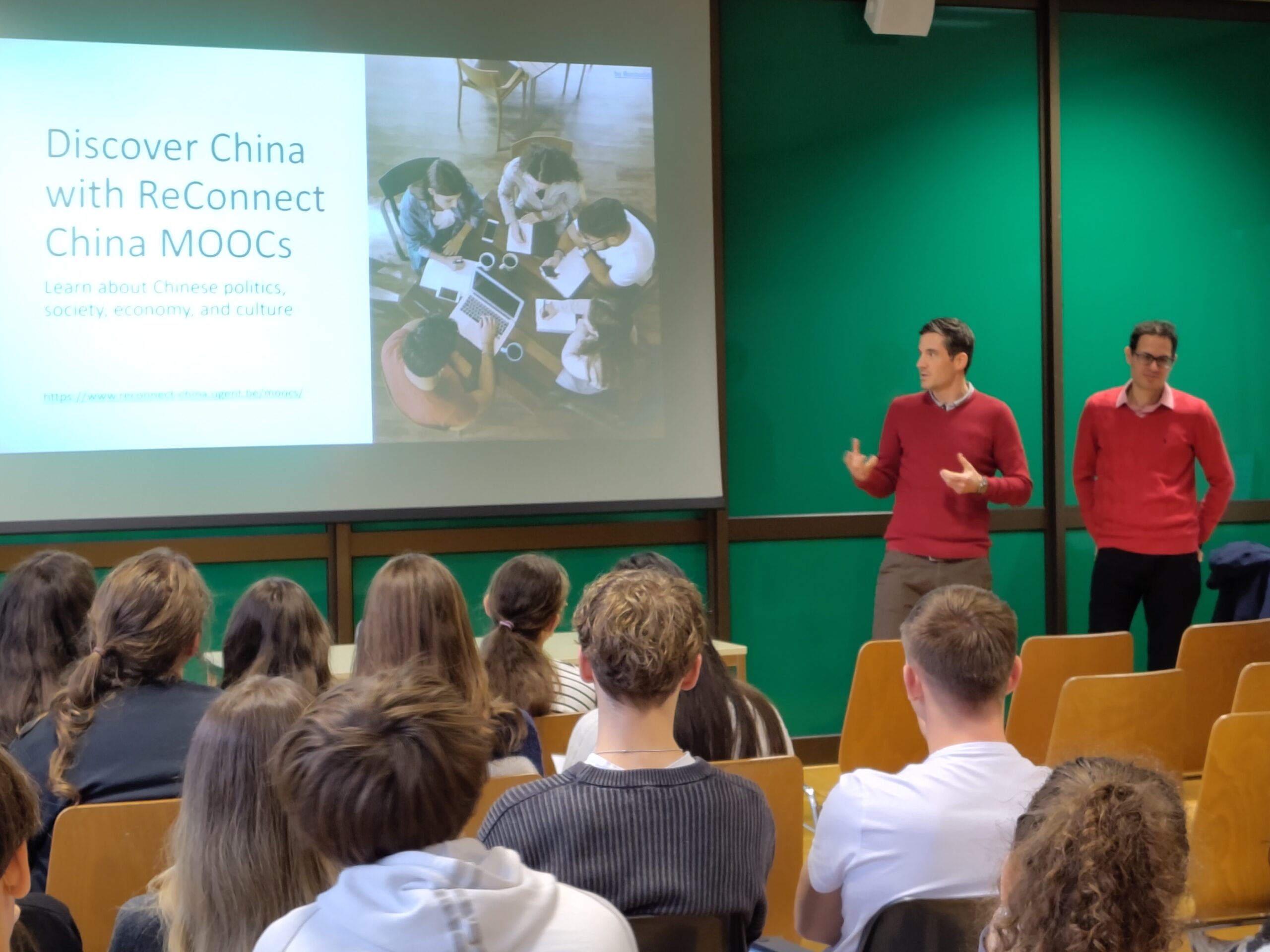
Gábor Szüdi and Philipp Brugner from ZSI had the pleasure to present the ReConnect China MOOCs and gave an introduction on China’s political and economic system to more than 30 students from classes 6A and 7A of Gymnasium Hartberg.

Gymnasium Hartberg is member of the European Parliament Ambassador School network and as such´ regularly involved in extracurricular activities related to European political education.

The Mentimeter results from this school visit can be found in this pdf.

Second school visit done: Discussing China with students in Vienna

As announced earlier on this website, ReConnect China experts are starting to get involved in school visits across Europe since September. On October 14, the second (after the March school visit by Victor De Decker in Aalst, Belgium) these school visits took place in Vienna.

Gábor Szüdi and Philipp Brugner, our team members from ZSI, visited the BORG 3 in Vienna-Landstraße, a public higher education school. This school is member of the European Parliament Ambassador School network and as such is regularly involved in extracurricular activities related to European political education.

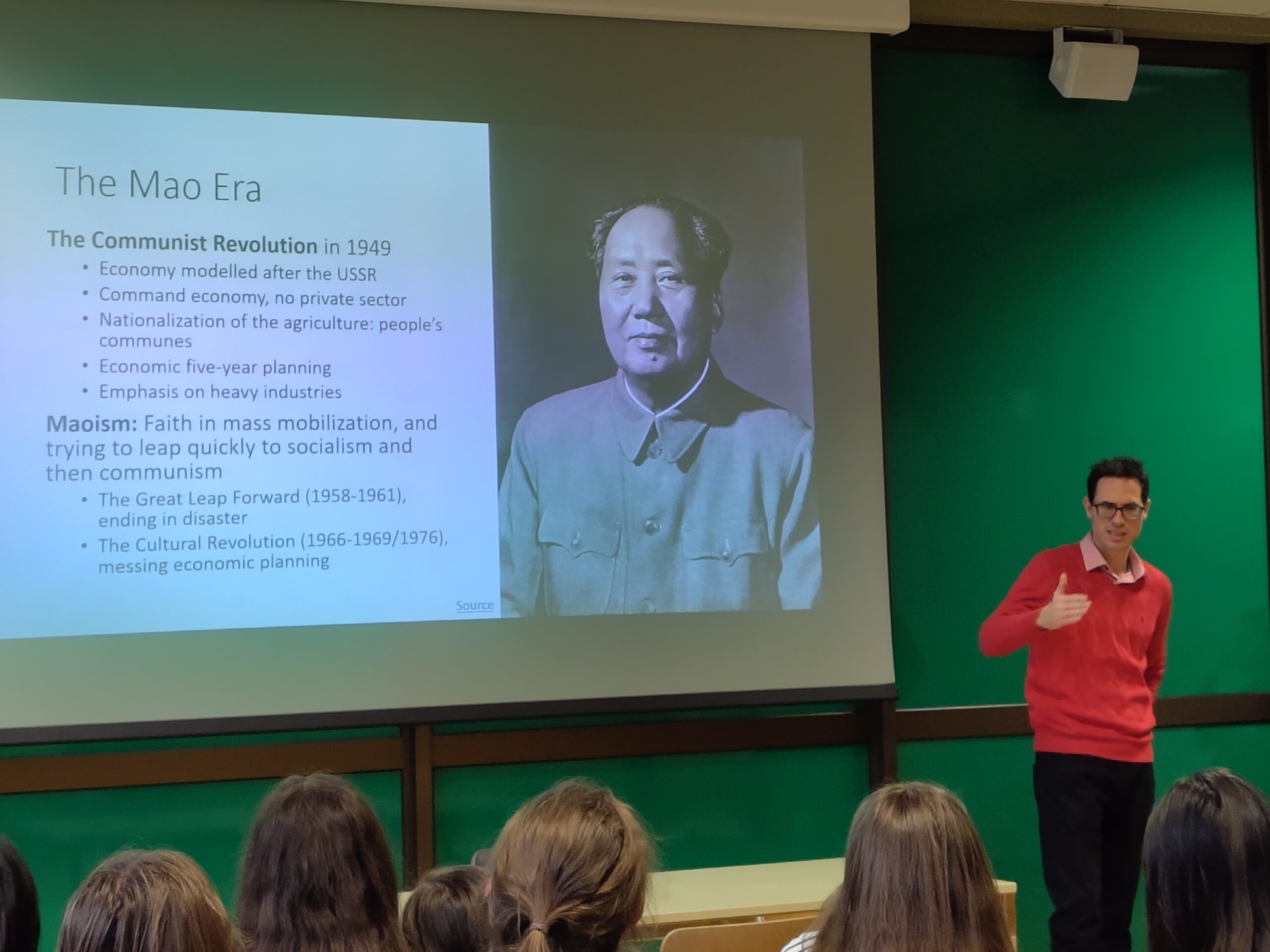
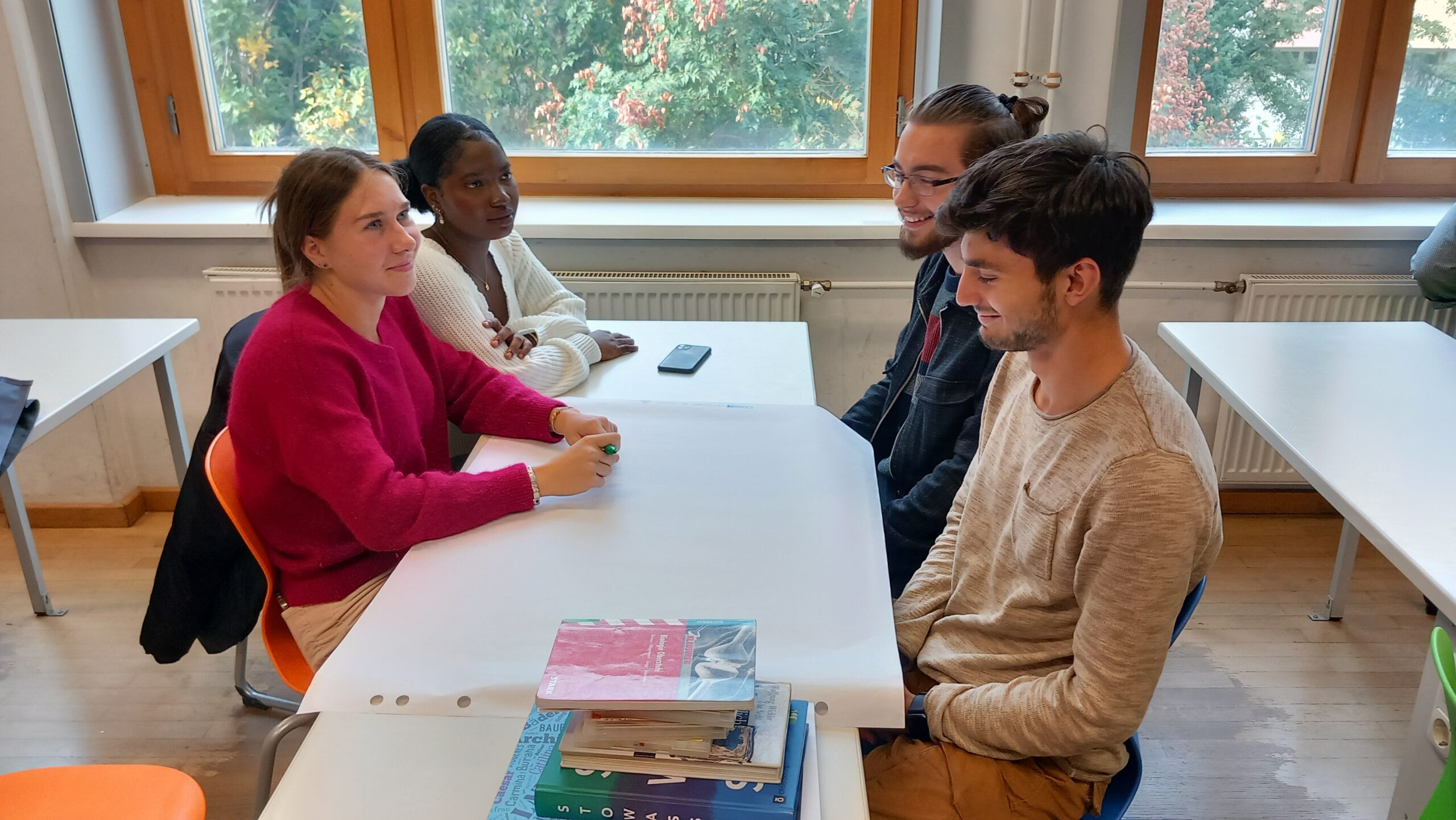
Over two hours, our experts engaged the group of eleven students in a lively discussion on China and its political and economic system in particular. They gave a presentation (its content was built on the learning materials prepared by the ReConnect China MOOCs) to quickly introduce the ReConnect China project and to outline the basics of the Chinese political (the party-state, the CCP, CCP structure, PRC central state institutions) and economic (the Mao era, the reform period – Deng Xiaoping, the Xi Jinping era, EU-China trade relations) system. With nine Mentimeter questions to provoke students having a guess about some specific facts relating to China, an interactive element with real-time results was added to spice up the presentation.

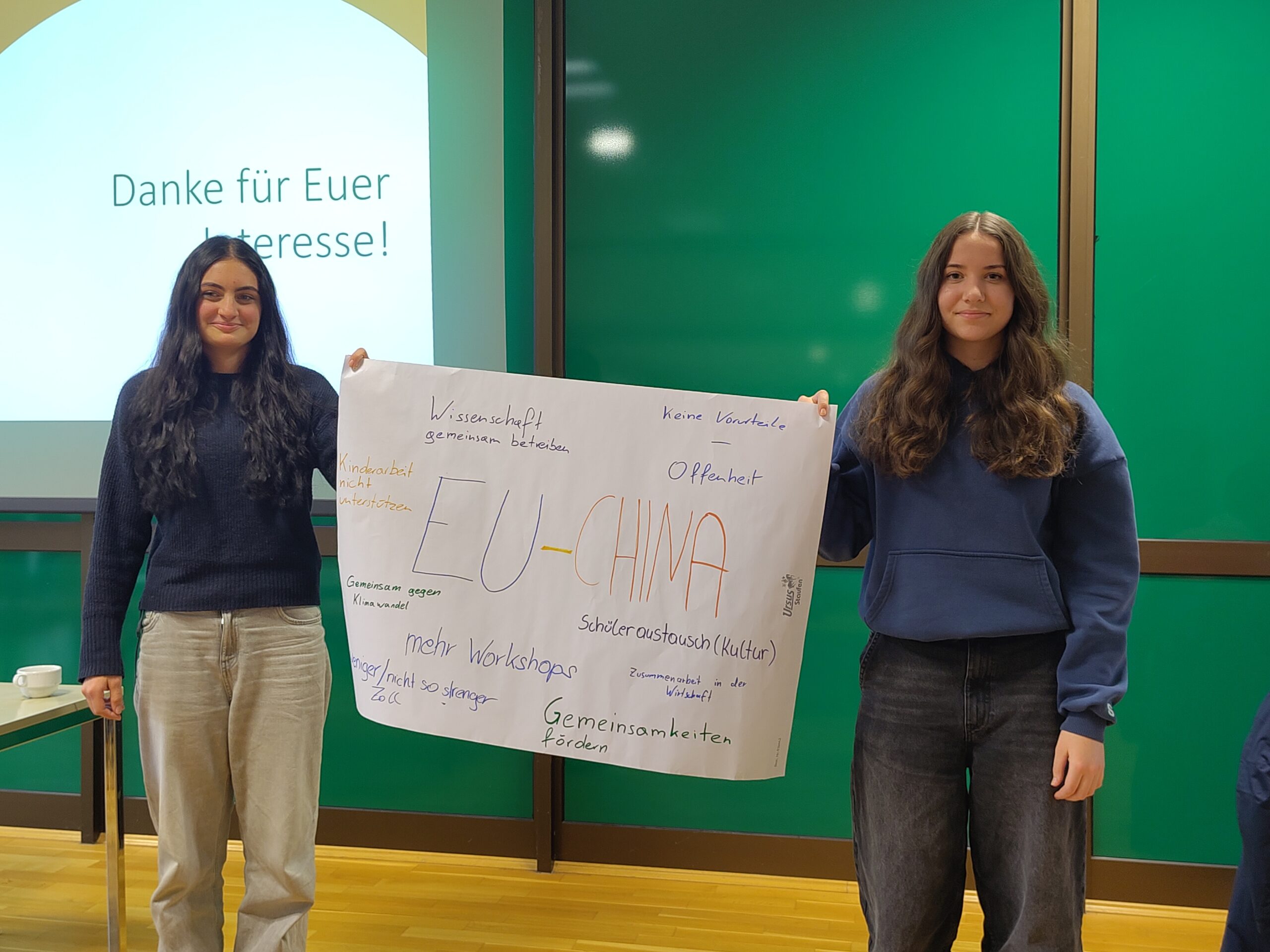
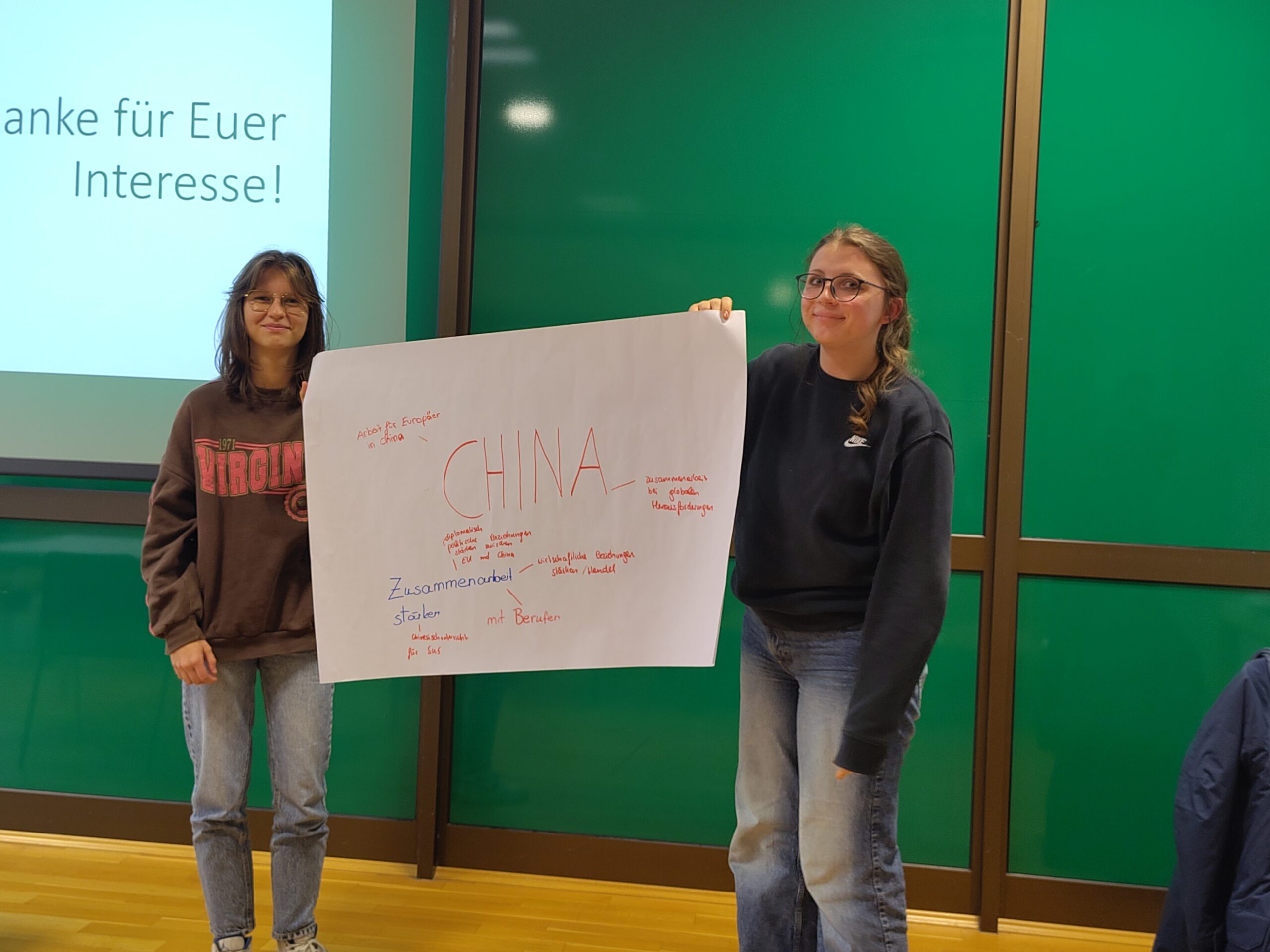
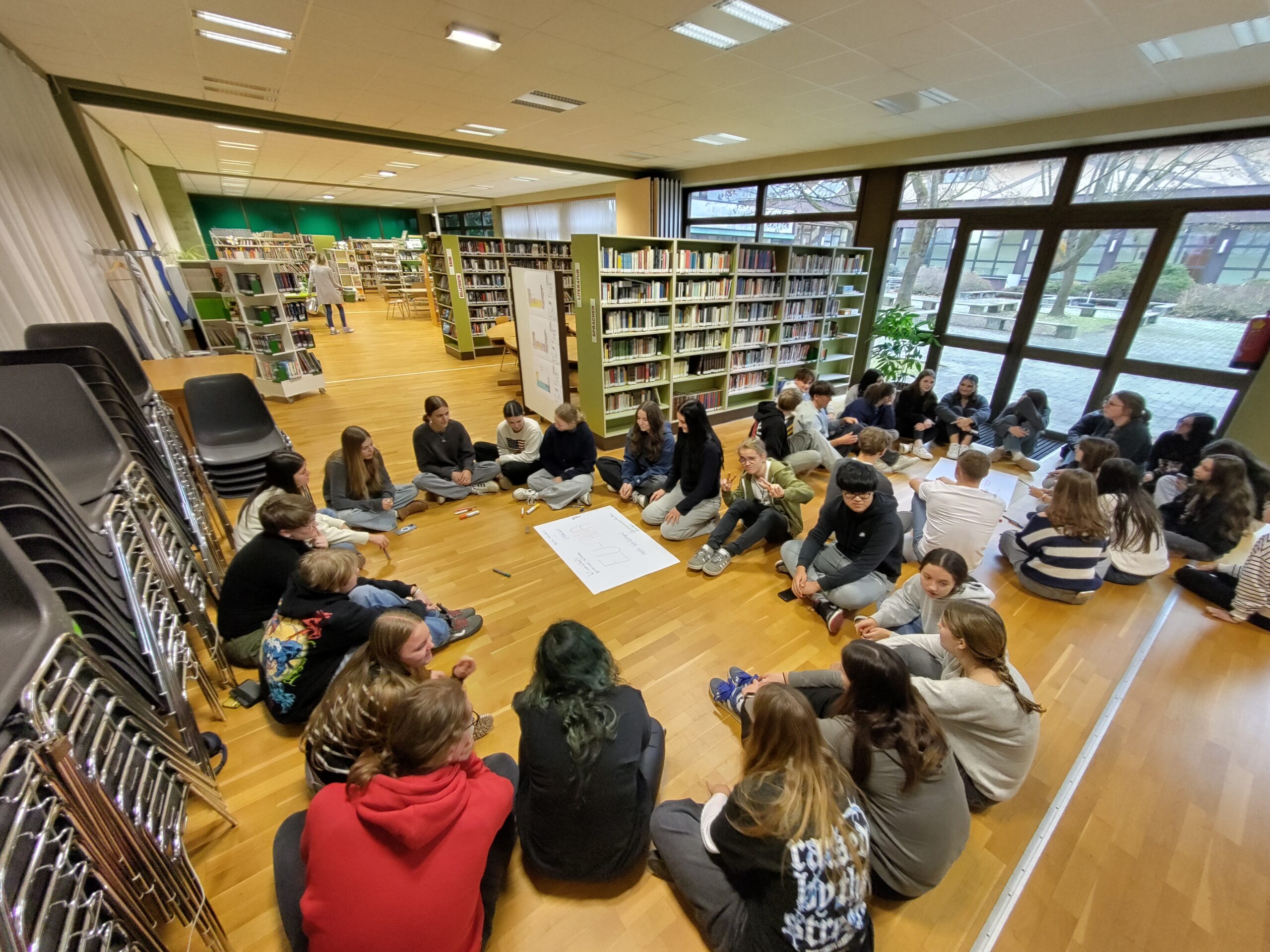
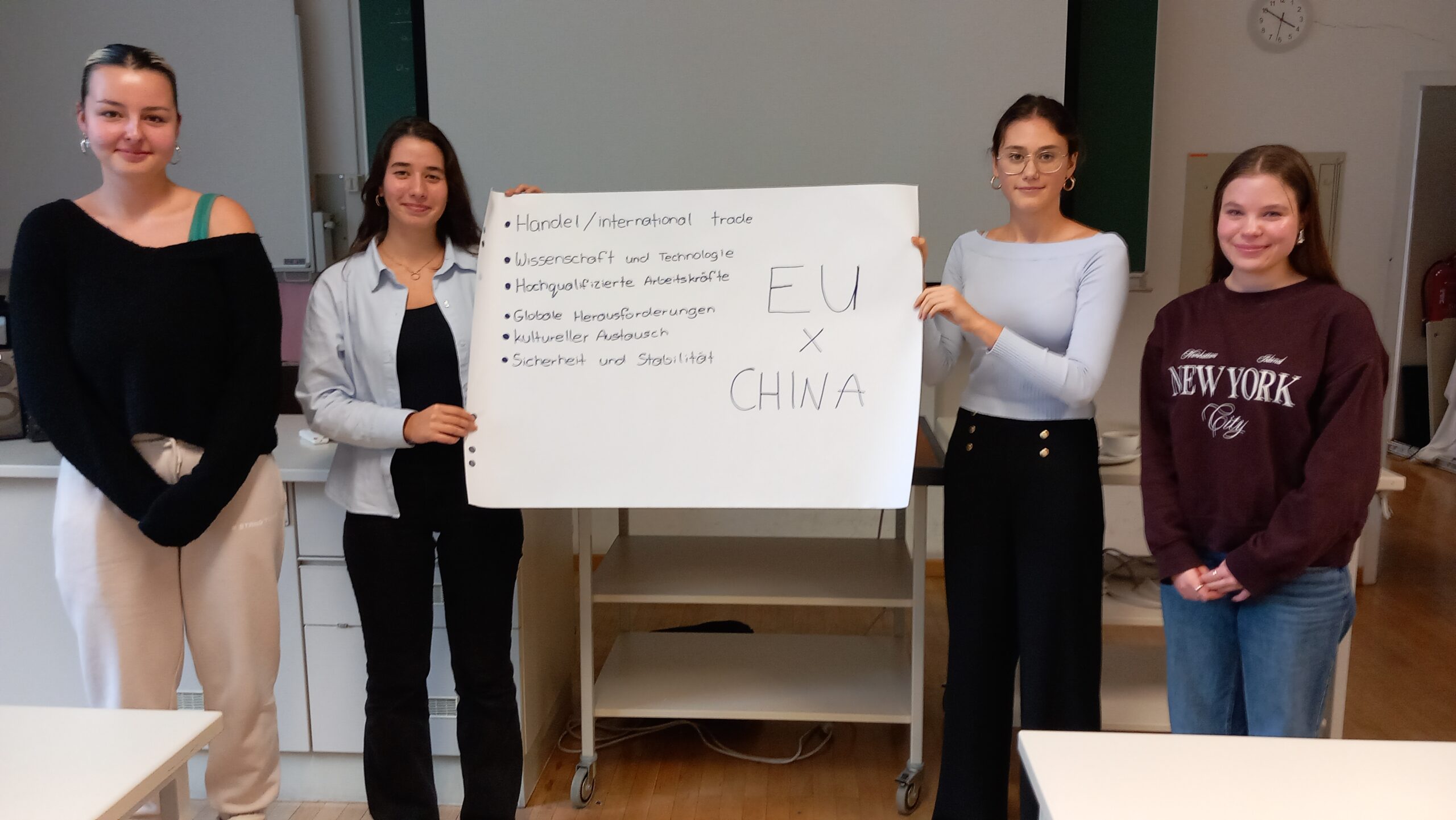
The visit concluded with a world café setting for two groups which took time to write up and visualise their thoughts, ideas and concerns regarding the future of EU-China cooperation.

From our side it was particularly interesting to present our work to a young and non-expert audience, requiring to choose a comprehensible language for a complex topic.

The results of the Mentimeter questions can be found in Vienna school visit_Mentimeter results


Research Security in R&I cooperation with China: ReConnect China at COST Workshop

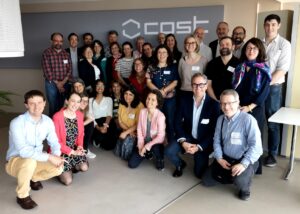
Recently, ReConnect China cooperated with the COST Association (European Cooperation in Science and Technology) for the organisation of a science diplomacy training. The training was held at the premises of COST in Brussels on June 20 and involved 30+ researchers from newly funded COST actions. Regardless of the scientific discipline these experts represented, the whole group had a keen interest to learn more about what science diplomacy is and how it is reflected in their own work as internationally oriented researchers.

Katalin Alfoldi from COST opened the training and explained why science diplomacy is important for COST actions. Mostafa Shawrav from the Marie Curie Alumni Association introduced the COST principal investigators to the origin of science diplomacy and how it is operationalised today across various sectors (instruments). Stella Reschke from the European Science Diplomacy Alliance and DLR – Project Management Agency updated on the EU’s strategic approach to science diplomacy. For ReConnect China, Philipp Brugner showed some results from ZSI’s work on EU-China STI cooperation and from its comparative assessment about how research security in the cooperation with China is applied in Higher Education Institutions across some EU Member States.

For more interaction, the training also included a group work and an interview with Ágota Dávid from the Permanent Representation of Hungary to the EU, who, given her professional career until now, is a real science diplomat in action.

This training was the second after the June 2023-edition, about which you can read more in this ReConnect China post.

Presentation for the CHERN working group on high-technology and innovation

On April 24, ReConnect China researcher Philipp Brugner (ZSI) took part in the CHERN (COST action: China in Europe Research Network) webinar on “EU-China cooperation in science, technology and innovation”.

Philipp presented the ReConnect China report on research and innovation cooperation in digital technologies between EU and China (main authors: Gábor Szüdi and Philipp Brugner, both ZSI) and its related policy recommendations, which were published in two separate policy briefs afterwards.

Since the publication of the report in September 2023 further empirical data was collected aimed at embedding the recommendations drawn in the real-life context of actors involved in R&I cooperation with China. For this reason, some interviews were carried out, complemented by desk research and personal interactions on the question of how to conduct trusted research cooperation with China while adhering to the research security standards and principles.

The CHERN webinar gave space to discuss the status quo of ReConnect China research done on scientific cooperation with China from a European point of view and opened it for critical reflection by working group members.


Interview on science cooperation with China in Austrian newspaper Die Presse: “Europa muss rote Linien definieren”

Gábor Szüdi and Philipp Brugner from our partner ZSI gave an interview to Austrian daily newspaper Die Presse about their report on science, technology and innovation cooperation between the EU and China in the field of digital technologies.

Together they spoke about practical examples where project-based cooperation between European and Chinese partners was reassessed after it was started due to risks of knowledge security or dual use. At the same time they re-emphasised the important status of China as a global partner to tackle the societal challenges of our time given the country’s strong scientific performance and its commitment to large-scale research and innovation investments contributing to tackling climate change, enhancing food security or further exploring the use of outer space by humans. Concludingly, they echoed ReConnect China’s general approach by underlining that trust-building between the two sides and at any level (national, institutional, individual) is crucial to shape reciprocally beneficial EU-China STI relations for the future.

You can find the interview on Die Presse online (with paywall).

Photo by Fernando @cferdophotography on unsplash.com

Presentation of the EU-China STI analysis for the meeting of the European Network for Academic and Scientific Exchange with China

On November 10, 2023, Philipp Brugner from ZSI, ReConnect China task leader on EU-China science, technology and innovation analysis, took part in the ENASEC – European Network for Academic and Scientific Exchange with China online meeting to present the main outcomes of the recently finished analysis in the context of the ReConnect China project.

About ENASEC: The European Network for Academic and Scientific Exchange with China (ENASEC) is a sub-project of ENTRANCE (Expertise & Transfer Network on China & Europe). It is intended to serve the regular exchange between German and European universities and research institutions on cooperations with China. The experiences, strategies and framework conditions for cooperations with China, which differ from country to country, represent a special enrichment, which can also give impulses for the own practice. Potentially, however, the project will also address much more concrete questions, such as the extent to which heterogeneous China strategies can also influence intra-European cooperation and what possibilities exist to use the common weight as a bargaining chip vis-à-vis Chinese partners. The experience gained in shaping relations with China is potentially transferable to the management of academic and scientific collaborations with countries that come with specific legal, ethical, or political challenges.

ReConnect China Policy Briefs no.2 and 3 draw policy recommendations on EU-China STI cooperation in the big data-related scientific fields

Based on the comprehensive report on EU-China STI cooperation in the big data-related scientific fields (artificial intelligence, big data and machine learning), two more policy briefs were published by the project. We used the report’s key results and aimed at embedding them in the overall policy discourse and legislative framework pertaining to science and technology cooperation between the EU and China. As a corollary, current developments in STI policy-making both on the EU’s and China’s side are explained, with a particular focus on the question how both actors aim to govern the future proliferation and protection of data stemming from research on AI, BD and ML from a legal viewpoint. The policy briefs conclude with a list of policy recommendations addressed both to the EU and the Member States level. While any risks or unfavourable conditions in research cooperation with China that could potentially conflict the EU’s interests and values must definitely be taken into account, we recommend European R&I actors to take case-by-case decisions on concrete research cooperation offers from their Chinese counterparts that are grounded in information provided by specific risk assessment and due diligence services.