Report on EU-China cooperation in science, technology and innovation published

At the beginning of September, ZSI finished its work on the report on EU-China cooperation in STI. The report is part of ReConnect China’s WP1 on science and technology and features a co-publication and co-patent analysis aimed at assessing the volume of cooperation between European and Chinese R&I actors. Due to their high relevance as emerging technologies and being of specific interest both to the EU and China, the study’s focus has been limited to the fields of Artificial Intelligence, Machine Learning and Big Data. Regarding the specific list of countries involved in this analysis, we defined “European countries” as the EU’s 27 Member States plus associated countries to Horizon Europe, namely the United Kingdom, Norway and Switzerland (= EU27/AC). In spite of the fact that only the UK has formally associated to Horizon Europe at the time of finalising this report, we decided to include Norway and Switzerland as well, given their strong role in the whole European R&I system. For both the co-publication and the co-patent analysis we worked with the latest data available from Web of Science from the PATSTAT database respectively (in both cases the period from 2011 to 2022).

Our analysis caters to the needs of a growing European demand to understand China’s involvement in science, technology and innovation cooperation with European actors better. At the same time, the empirical findings discussed in this report may be conducive to national and European R&I policy makers alike, given the on-going debate on how to address research cooperation with China in the future in the light of mounting concerns about security risks, the disregard for research integrity and the misuse of civilian research for military purposes (dual use).
ReConnect China_D1.1_Report on the results of research cluster on EU-China research cooperation_co-patent,co-publication analysis

Science Diplomacy Collaboration with China – ReConnectChina represented at COST Workshop

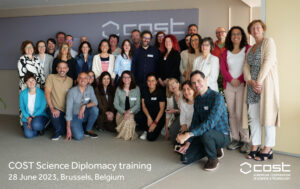
In the framework of a science diplomacy workshop organised by the COST Association for new COST (European Cooperation in Science and Technology) Actions on 28 June 2023, ZSI researcher Gábor Szüdi had the chance to present the co-operation risks and potentials with China (as an example of a ‘non-like-minded country’) within collaborative R&I projects, using the tools of science diplomacy.
The presentation highlighted the differences between the EU and Chinese interpretation of STI co-operation and science diplomacy, drawing also on national examples, explaining the inherent tensions that might be successfully mitigated by the ongoing work in ReConnectChina.
The workshop therefore served also as an excellent opportunity to introduce high-level researchers from all around Europe (principal investigators of COST Actions in manifold thematic areas) the thematic foci and strategic priorities of ReConnect China.

Research from ReConnect China at the EU-SPRI 2023 conference

The annual EU-SPRI conference is the leading European event on science, technology and innovation (STI) policy. This year’s conference on the theme “Research with impact” took place from June 14 – 16 at the University of Sussex Business School in the UK. ReConnect China researcher Philipp Brugner (ZSI) together with Robin Schindowski from Bruegel, researcher in our sister project “China Horizons”, took part in the conference with a paper stemming from their joint work in the two EU-funded projects.

The paper deals with a descriptive approach towards China’s state-controlled R&D financing for companies and research institutions in the clean energy sector. It sheds more light on the various channels through which the government participates in their R&D activities, which, despite their complexity and the challenge to map all of them (in particular when it comes to China’s regional levels), may be categorised along the following three prevalent types:

  • National Key R&D programmes
  • Firm-level R&D subsidies
  • Government equity participation (in so called “SOE” – state-owned enterprises)

Given these ways of vertical governmental innovation support to accelerate the development of clean energy technologies as a current top-priority for Chinese leaders, the research paper, towards its final structure, further aims to carve out as well as quantify some of the trade-offs associated with China’s approach to harness vertical innovation support as a means to do industrial policy. As China is world-leader in manufacturing (and increasingly also in design and innovation) of clean energy technologies, this paper may also be situated in the European Union’s current debate about de-risking from China (by decreasing the EU’s import dependency) while decarbonising the European industry to meet the goals stipulated by the Green Deal until 2030 and 2050.

First public report on EU-China STI cooperation forthcoming in August 2023

ZSI works on a study to shed light on research and innovation cooperation patterns between EU MS and China

The first public report of ReConnect China will be available in August 2023 and work on it has already started. ZSI leads on developing a report assessing cooperation patterns between R&I actors in China and the EU Member States. The study will be based on two specific dimensions of analyis:

  • Co-patenting analysis (last 10 years) based on EPO PATSTAT Global 2022 single edition (worldwide patent database: PATSTAT contains bibliographical and legal status patent data from leading industrialised and developing countries): The objective is to identify both prevalent, but also emerging cooperation networks between R&I institutions and private companies in China and the EU MS based on jointly filed patents
  • Co-publication analysis (last 10 years) based on Web of Science data for jointly authored scientific works between institutions/individuals from EU and China (classified by Science-Metrix ontology): The objective is to identify both prevalent, but also emerging cooperation networks between R&I institutions (research institutes and universities) in China and the EU MS based on jointly co-authored scientific publications

The analysis will be compared against the current policy background pertaining to EU-China negotiations and frameworks for cooperation in science, technology and innovation. At the end, the report’s findings shall be conducive for answering the following questions:

  1. In which economic sectors (based on co-patenting activities) and scientific fields (based on co-publication activities) does cooperation take place?
  2. What are challenges, drivers, perils, but also opportunities for EU partners when cooperating with China in STI?
  3. Do the cooperation patterns identified correspond to recommendations made in official EU policy documents related to STI (EU Global Approach to R&I/2021, Tackling R&I foreign interference/2022 etc.)?